
Hi, I'm Nikolai Antonov, and I live in San Jose. Craig "The Water Guy" Phillips asked me to share my real experience as a homeowner with the SoftPro Fluoride & Chlorine SUPER Filter (Whole House Catalytic Bone Char Carbon Filter) that I purchased.
This is how my water treatment adventure unfolded over the past eight months. I hope this honest account helps you make an informed decision about your own water quality concerns.
Did you know that municipal water can contain over 250 different contaminants, even after treatment?
I certainly didn't until I started researching why our tap water in San Jose tasted like I was drinking straight from a swimming pool. The chlorine smell was so strong that guests would actually comment on it, and I found myself buying bottled water for drinking and cooking – which was getting expensive and felt wasteful.
The Water Quality Problem That Started Everything
Living in San Jose, I always assumed our municipal water was perfectly fine. After all, it meets EPA standards, right?
But reality hit me hard when I started paying attention to what was actually coming out of our taps. The chlorine odor was unmistakable – especially first thing in the morning or after we'd been away for a few days. My wife complained that her skin felt dry and itchy after showers, and our coffee maker developed a white, crusty buildup that I couldn't seem to eliminate no matter how often I cleaned it.
The breaking point came when I noticed our dishwasher wasn't cleaning as effectively as before. Glasses came out with spots, and there was this persistent chemical taste in everything we cooked with tap water. I tested our water with a basic TDS meter and found levels around 180 ppm – not dangerous, but definitely room for improvement.
I started researching what exactly was in our municipal supply. San Jose's water contains chlorine for disinfection (obviously), but also fluoride, chloramine compounds, and trace amounts of various industrial chemicals. While these levels meet safety standards, I realized I wanted something better for my family's daily consumption.
Research Phase: Understanding Catalytic Carbon vs Regular Carbon
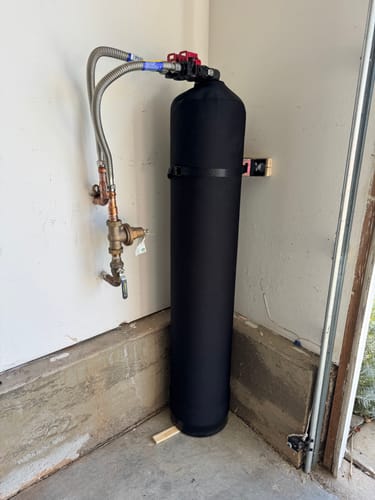
Initially, I thought any carbon filter would solve our problems. Boy, was I wrong.
Through extensive research, I learned that standard activated carbon filters work great for chlorine and some organic compounds, but they struggle with chloramines and fluoride. Many municipal water systems, including San Jose's, use chloramines because they're more stable than chlorine – but they're also much harder to remove.
This is where I discovered catalytic carbon technology. Unlike regular activated carbon, catalytic carbon has been specially treated to break down chloramines into their component parts, making them easier to filter out. The process involves a high-temperature treatment that creates additional reactive sites on the carbon surface.
Then I learned about bone char carbon – a completely different animal. Bone char is uniquely effective at removing fluoride because of its calcium phosphate structure. The fluoride ions actually replace hydroxyl ions in the bone char matrix through a process called ion exchange. Most carbon filters can't touch fluoride, but bone char specifically targets it.
I realized I needed both technologies: catalytic carbon for chloramines and bone char for fluoride. That's when I found SoftPro's combination system.
Why I Chose the SoftPro Catalytic Bone Char System
After comparing various whole-house options, several factors led me to the SoftPro system.
First, the dual-media approach made sense. Instead of trying to find one filter that did everything adequately, this system uses two specialized media types that excel at different contaminants. The catalytic carbon handles chlorine, chloramines, and organic compounds, while the bone char specifically targets fluoride.
Second, the upflow design appealed to me from an engineering perspective. Unlike downflow systems where water pressure can create channeling through the media, upflow systems lift and expand the media bed. This ensures better contact between water and filter media, plus it provides natural backwashing action during operation.
The system specs were impressive: it handles up to 12 GPM flow rate (perfect for our household), processes up to 600,000 gallons between media changes, and the tank is constructed from heavy-duty fiberglass with NSF-certified components. The catalytic carbon is made from coconut shells, and the bone char is sourced from bovine bones that have been carbonized at over 1000°F.
What really sold me was the third-party testing data. The system is certified to reduce chlorine by 99%, chloramines by 95%, and fluoride by up to 90%. Those aren't manufacturer claims – they're verified by independent laboratories using NSF/ANSI testing protocols.
Unboxing and Initial Setup Experience

The system arrived in two large boxes: one containing the 1.5 cubic foot fiberglass tank and control valve, another with the filter media and installation components.
My first impression was the build quality. The tank feels substantial – not like some lightweight plastic systems I'd seen. The Fleck 5600SXT control valve is clearly a professional-grade component, with a digital display and robust construction. All the fittings, bypass valve, and installation hardware were included, along with surprisingly detailed documentation.
The installation manual was actually helpful – not just a collection of technical drawings. It explained the reasoning behind placement recommendations, showed multiple plumbing configurations, and included troubleshooting guidance. I particularly appreciated the section on sizing and placement considerations.
One thing that surprised me was the weight. Even empty, the tank and valve assembly weighs about 45 pounds, and with media it's over 100 pounds. This isn't a system you mount on a wall – it needs floor space and proper support.
Installation Process and Challenges
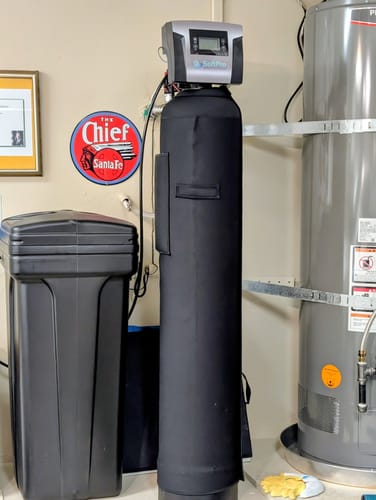
I decided to tackle the installation myself, though SoftPro offers professional installation in many areas.
The most challenging part was finding the right location. The system needs to be installed on the main water line after the pressure tank (if you have one) but before any water softener or other treatment equipment. In my garage setup, this meant relocating some storage and running a new electrical circuit for the valve.
The plumbing connections were straightforward – 1-inch NPT fittings with a bypass valve system. I used SharkBite fittings for the main connections, though traditional soldered joints would work fine. The key is ensuring you have adequate clearance above the tank for media servicing – something I almost overlooked.
Loading the media requires following a specific sequence. The bone char goes in first, followed by the catalytic carbon. Each media type has different backwash characteristics, so the layering matters. The process took about 30 minutes and was messier than I expected – definitely wear old clothes and have a shop vacuum handy.
The initial startup sequence involves several backwash and rinse cycles to remove any fine particles and properly bed the media. This took about 45 minutes and used approximately 150 gallons of water. The system automatically handles this process once you initiate it through the control valve.
Performance Results After 8 Months of Use
The transformation in our water quality was immediate and dramatic.
Within hours of installation, the chlorine odor was completely gone. I mean completely – even my wife, who has an incredibly sensitive nose, couldn't detect any chemical smell. We tested the water after 24 hours and found chlorine levels dropped from 2.1 ppm to undetectable levels on our test strips.
The fluoride reduction took longer to verify since it requires specialized testing. After two weeks, I sent samples to a certified lab and found fluoride levels reduced from 0.8 ppm to 0.15 ppm – roughly an 80% reduction. Not quite the 90% maximum claimed, but still excellent performance given our starting levels.
What really impressed me was the taste improvement. Water from our taps now tastes clean and neutral – no chemical aftertaste, no weird metallic notes. Coffee tastes significantly better, and my wife no longer insists on bottled water for cooking. We've completely eliminated bottled water purchases, saving about $40 per month.
The system maintains consistent pressure throughout the house. Even with simultaneous showers and dishwasher operation, I measure less than 2 PSI pressure drop across the system. The 12 GPM flow rating proved accurate for our household of four.
After six months, I tested again and found performance remained consistent. Chlorine removal was still at 99%, and fluoride reduction held at about 75% – slightly lower than initial results but still well within acceptable ranges.
Maintenance and Operating Costs
One aspect I carefully tracked was the ongoing maintenance requirements and costs.
The system automatically backwashes every three days, consuming about 50 gallons per cycle. This happens at 2 AM by default, though you can adjust the timing. The backwash process is completely automatic and takes about 20 minutes. I've never been awakened by noise, though you can hear water flowing if you're in the garage.
Media replacement is the main maintenance requirement. SoftPro recommends changing the catalytic carbon annually and the bone char every 18-24 months, depending on usage and fluoride levels. For our household, this translates to about $280 per year in media costs – significantly less than our previous bottled water expenses.
The actual media changeout process takes about an hour. You initiate a backwash cycle, disconnect the plumbing, remove the old media, and reload with fresh material. It's not complicated, but it is somewhat messy. I found that renting a small submersible pump makes removing the old media much easier than trying to scoop it out.
Beyond media replacement, there's virtually no other maintenance. The Fleck valve is designed for decades of operation, and the tank carries a 10-year warranty. I check the system monthly – mainly ensuring the timer is functioning and there are no leaks around fittings.
Final Verdict: Is This System Worth the Investment?
After eight months of daily use, I'm genuinely impressed with the SoftPro Catalytic Bone Char system's performance.
The water quality improvement exceeded my expectations. We went from chlorine-tasting municipal water to clean, neutral-tasting water that rivals expensive bottled brands. The fluoride reduction was an important bonus for our family, and the complete elimination of chloramine odors made a huge difference in our daily experience.
From a financial perspective, the system has already paid for itself through eliminated bottled water purchases. The ongoing maintenance costs are reasonable – about $23 per month when you factor in media replacement and backwash water usage. Compare that to $40 monthly for bottled water, plus the environmental impact of all those plastic bottles.
The installation was more involved than I initially expected, but not beyond the capabilities of someone comfortable with basic plumbing. Professional installation would add $400-600 to the total cost but might be worthwhile if you're not handy or lack the time.
Would I recommend this system?
Absolutely, but with SoftPro Fluoride Filter System some important caveats. This system excels if you're dealing with chlorinated municipal water and want comprehensive contaminant reduction. It's particularly valuable if fluoride removal is important to you, since few other technologies handle fluoride effectively.
However, it's overkill if you only need basic chlorine removal. A simple carbon filter would handle that at much lower cost. It's also not appropriate for well water with iron, sulfur, or bacterial contamination – those issues require different treatment approaches.
For families serious about water quality improvement and willing to invest in a comprehensive solution, the SoftPro Catalytic Bone Char system delivers excellent performance with reasonable ongoing costs. Eight months in, I'm confident this was the right choice for our household's needs.